

Imagine buying a state-of-the-art sports car, leaving it in second gear, and using the back seat purely to store groceries. It sounds absurd, but that is precisely how millions of growing businesses approach their technology every day.

Imagine buying a state-of-the-art sports car, leaving it in second gear, and using the back seat purely to store groceries. It sounds absurd, but that is precisely how millions of growing businesses approach their technology every day.

Small businesses miss out on lucrative enterprise contracts every day for reasons unrelated to their core services. The deal usually stalls when the big prospect hands over a vendor security questionnaire, and the SMB blinks.
Let’s talk about how we can better prepare you to close these deals, and make you less likely to choke.

Relying on reactive, hourly IT support is an inefficient and expensive way to manage business technology. While paying for IT services only when something breaks appears cost-effective, the model creates a direct conflict of interest. An hourly IT provider generates revenue when technology fails, meaning they lack the financial incentive to prevent issues from occurring.

Many small and medium-sized businesses are willingly tolerating massive, hidden technical friction in other areas of their operations—and it’s draining their budgets. Technology is a major operating expense, yet countless organizations continue to pour capital into software licenses, duplicate applications, and emergency support models that offer zero business return.
Let's unpack the two primary areas where your business is likely bleeding cash, and how adopting a proactive posture can transform your technology from a budget liability into a competitive engine.

Every technology provider has a list of core values plastered on their website. They love using words like efficiency, innovation, and speed. While we use these outcomes as much as anyone, I want to be completely candid about the real boundary line in modern IT. Right now, there is a constant conflict happening between security and convenience.
Convenience demands fewer clicks, shorter passwords, bypassed logins, and instant access to everything from any device. Security requires verification, data encryption, strict access parameters, and deliberate authentication checks. When these two forces collide, our engineering team operates under a strict rule: security wins over convenience every single time. This core mindset guides every decision we make when we work with our clients.

When a growing company hires its first internal IT Director, it marks a significant organizational milestone. The business finally reaches a size where it requires dedicated technology leadership rather than relying on a tech-savvy office manager to reboot the network router. However, a single technology leader quickly faces a severe operational bottleneck.
A typical day often gets consumed by manually troubleshooting tasks like configuring legacy shipping printers, resetting user passwords, and setting up dual-monitor workstations. While these immediate tasks are necessary to keep employees working, they prevent the IT Director from addressing critical backend infrastructure needs. When an internal manager is occupied with daily hardware adjustments, nobody is reviewing firewall logs, running phishing simulations to train staff, or auditing the company compliance posture.

When a small business grows, the workload for a single internal IT manager often becomes unsustainable. Your technical lead spends most of their time resolving repetitive desk requests, which prevents them from executing the strategic projects required to improve business operations.
This overextension frequently results in delayed projects, security vulnerabilities, and employee turnover. Your top technical staff members will eventually seek employment elsewhere if they cannot focus on meaningful technical work.
Every single day, your business generates massive amounts of operational data. When a core database or financial record suddenly becomes inaccessible, your operations halt immediately. The primary vulnerability for most companies right now is an over-reliance on legacy security tools.

The antiquated approach to managing information technology support brings a massive amount of financial volatility to your business. You wait for something to break, your team suffers through unexpected downtime, and then you pay an unpredictable invoice to get everything running again. It is an unstable loop that makes budgeting impossible and creates immense operational stress.

Many small business owners view IT expenses as a series of unavoidable, expensive surprises. Under the traditional break-fix model, you only pay a technician when something actively stops working. While this sounds logical on paper, it creates massive financial volatility for your cash flow and completely derails your long-term planning. A major server failure or network crash results in an unexpected, four-figure invoice that disrupts your operations.
Cybersecurity has gotten more complex than ever, with many of the old standbys being rendered obsolete in comparison to the threats they are meant to prevent. Pairing that with the fact that many attacks are waged against small and medium-sized businesses, which often lack proper protections, makes the risk clear.
That said, you don’t have to accept these risks. Instead, you can implement tools like endpoint detection and response.

When we sit down and watch a movie, we love a hero who arrives just in time to defuse a ticking clock. In business, however, the ticking clock is actually your company’s overhead, and every second it ticks during a system outage is money evaporating.
As far as your business is concerned, we have a bit of a contrarian view: if your IT provider is constantly saving the day with dramatic, late-night heroics, it’s a sign that your technology strategy is actually failing you.
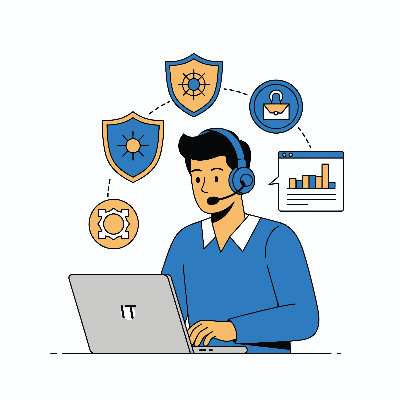
I was talking to a friend the other day who runs a successful company. He’s the type of guy who knows his inventory down to the last decimal point. Still, when we sat down for coffee, he looked exhausted.
"I’m just so tired," he said, "One day the printer is offline, the next day one of my guys can’t sync his files. Just this morning, I got a suspicious email that looked a little too much like an invoice from my own CPA. I’m spending four hours a week playing the IT guy. I don’t know what I’m doing."

Once upon a time, a small business could conceivably make it relying on amateur or semi-professional technical support. This is no longer the case.
Nowadays, business IT is so crucial that a professional touch is a hard requirement for success… for reasons you may not initially consider.
As a business scales, a break-fix mentality becomes a massive anchor. It may have worked when you first hung out your shingle, but you aren’t just managing laptops anymore; you’re managing cybersecurity threats, cloud migrations, and data compliance.
This is where Managed Services Providers (MSPs) come in. The MSP may be an outside contractor, but it really is a specialized engine you plug into your business to handle the technical stuff.

For a fun little exercise, imagine you’ve just signed up for our managed IT services. Everything’s well and good, but then, something goes wrong with your computer. What gives? Aren’t we supposed to prevent issues from occurring in the first place? It’s easy to get discouraged when freak situations like this occur, but it’s important to highlight what proactive IT solutions can do, and more importantly, what they can’t do.

As we push onward into 2026, it’s helpful to remember that the “good old days” are not necessarily as good as we remember them to be. When you would call your technology provider to deploy a patch or upgrade a system, you weren’t necessarily being “proactive”; you were being reactive without realizing it. In fact, managed service providers have evolved their model to reflect major disruptions in the tech industry.

If you had to be honest with yourself, does your technology strategy revolve around your business’ plans, or is it tied more closely to your inevitable hardware failures? Many businesses still operate in the break-fix sense. When a laptop breaks, they replace it… but this reactive spending is costing your business in the long run, and it all but ensures you’re two steps behind. To stay competitive, you need tech goals that align with your business, supported by a Virtual Chief Information Officer who understands your business inside and out.

Is the “break-fix” cycle of IT quietly (or not so quietly) draining your company’s annual profit? Many businesses operate from the perspective that if the computer is running, it’s doing the job and isn’t costing the business anything. This is a fallacy, and one that could be costing your business. In truth, this silent leak could be costing your business thousands in billable hours, emergency repair premiums, and staff frustration.

One of the inevitabilities of starting and operating a successful business is that your IT infrastructure will eventually outgrow itself. While you might have been able to start operations with just a couple of people, the same network that used to work just fine is likely bowing under the stress of additional employees and workstations. If you want to build a sustainable and reliable infrastructure, it’s best that you rely on experts who can help your company stay as competitive as possible, regardless of how much you grow.
Contact Us
Learn more about what PCSOFT can do for your business.
PCSOFT
Suite 2.07, 3 Fordham Way
Oran Park, NSW 2570